
Which Broadleaf Weeds Take Over Knoxville Lawns in Winter?
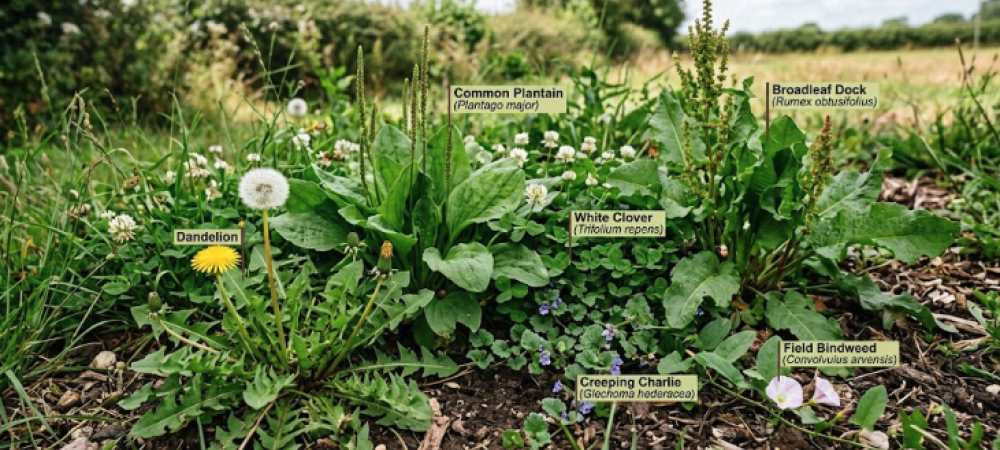
The usual group is henbit, purple deadnettle, common chickweed, corn speedwell, and hairy bittercress, joined by perennials like wild violet, ground ivy, and white clover that stay visible while the grass slows down. All of the annuals in that list germinate in fall, sit low and small through the cold months, then flower and set seed in early spring.
That life cycle is the reason a lawn can look clean in November and look overrun in March. The weeds were there the whole time. They were just too small to notice.
How to Tell the Common Ones Apart
Identification matters more than it sounds, because control timing and product selection change depending on the weed and the turf species it is growing in.
Henbit has square stems and rounded, scalloped leaves that wrap directly around the stem with no leaf stalk. The purple flowers appear in whorls near the top of the plant. This is the weed responsible for the purple haze across lawns and fields in early spring.
Purple deadnettle is a close relative and gets confused with henbit constantly. The tell is the leaves: deadnettle leaves are more triangular, they attach by a short stalk, and the uppermost ones take on a reddish purple tint. Both have square stems and both flower at the same time.
Common chickweed forms low mats of small, smooth, oval leaves with tiny white flowers. It prefers moist, shaded, cooler ground, so it tends to show up on the north side of the house, under trees, and in low spots that stay damp.
Corn speedwell stays very low, with small hairy leaves and tiny blue flowers. It thrives in thin turf and bare spots, which makes it a good indicator of a canopy problem rather than a weed problem.
Hairy bittercress grows as a small rosette and sends up a thin stalk of white flowers. Its seed pods burst open when disturbed and fling seed several feet, which is why one plant in a bed turns into a colony the next year.
One important distinction: annual bluegrass, or Poa annua, shows up on the same calendar and often in the same patches, but it is a grass, not a broadleaf weed. Broadleaf treatments do not control it. That is a common source of frustration when a lawn gets treated and half the weeds disappear while the light green clumps stay.
What Your Weeds Say About Your Lawn
Weeds are opportunists, and the pattern of which ones show up tells you something about the growing conditions:
- Speedwell, chickweed, and heavy annual pressure across open areas point to a thin canopy. Something reduced turf density the previous summer.
- Ground ivy and violets under trees point to shade and moisture, where turf is genuinely struggling to hold density.
- Clover spreading across an otherwise healthy lawn often points to low nitrogen availability, since clover fixes its own.
- Plantain in walkways and play areas points to compaction.
That is why weed control that only treats what is visible tends to repeat itself annually. The lasting fix is a canopy dense enough that seed cannot reach soil and germinate. UT Extension makes the same point plainly: the best defense against lawn weeds is healthy, thick turfgrass.
Why Do Weeds Grow in Winter When the Grass Doesn't?
Because they are built for the opposite season. A winter annual germinates in fall as soil temperatures drop, grows through winter whenever conditions allow, completes its life cycle in spring, and dies off in summer heat. University of Tennessee Extension groups chickweed and henbit as classic winter annuals for exactly this reason, and notes that knowing a weed's life cycle is what determines the right timing for control.
They also get very little competition. Zoysia and bermudagrass lawns in the Knoxville area go dormant once soil temperatures drop, leaving open canopy and bare soil for months. Tall fescue stays greener but slows down significantly, and any area that thinned out during summer heat or disease pressure is an open invitation. Thin turf in September becomes weedy turf in February.
Not sure what is coming up in your lawn, or when it should be addressed? Reach out to Grover Turf Care for professional weed control in Knoxville and surrounding areas.